Sandbach's Crosses and their Irish cousins: stone, story and a nation's love of a game
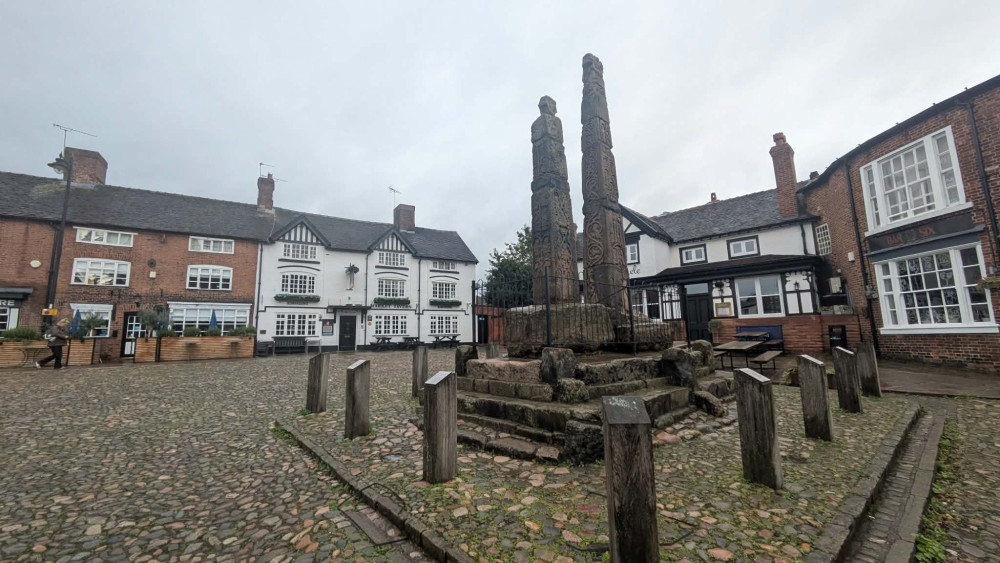
The two ancient crosses in Sandbach's Market Square are among the finest Anglo-Saxon carvings in England. Look a little further west, across the Irish Sea, and you'll find their relatives, along with a surprising story about how the same craftsmanship was used for play.
The crosses on the cobbles
Most of us walk past them without a second glance. The Sandbach Crosses have stood in the Market Square for well over a thousand years, and they have had an eventful life. Carved in the ninth century, they were broken up centuries later, their pieces scattered around the town and beyond. They were painstakingly gathered and re-erected in the early 1800s, which is why they stand where they do today.
Look closely and the weathered sandstone comes alive. The taller north cross is packed with scenes from the life of Christ, including the Annunciation and the Crucifixion. Figures, animals and vine scrolls crowd every surface, knotted together with interlace patterns that seem to have no beginning and no end.
They were built for a world where most people could not read. The crosses were a sermon in stone, telling stories that anyone in the square could follow.
Their Irish cousins
Sandbach's crosses weren't made in isolation. Across the Irish Sea, the same period produced some of the most celebrated stone monuments in Europe: the Irish high crosses.
The most famous is Muiredach's Cross at Monasterboice in County Louth. At more than five metres tall, it is covered with biblical scenes arranged in panels, much like the ones in our own Market Square. At Clonmacnoise in County Offaly, the Cross of the Scriptures does the same. At Ahenny in County Tipperary, the crosses are almost entirely covered with intricate interlace and spirals.
The similarities are no accident. Monks, missionaries and craftsmen moved between Ireland, northern England and the Midlands, carrying ideas, styles and stories with them. Christianity in the kingdom of Mercia, which included Cheshire, owed a great deal to missionaries who had trained in the Irish tradition. It is little wonder that researchers in Ireland today study Sandbach's crosses alongside their own.
Stand in the Market Square and you are looking at a shared artistic language that stretched from the Cheshire plain to the monasteries of the Irish midlands.
The same craftsmanship, used for play
That shared language wasn't reserved for churches and monuments. It also turned up in everyday life, including at the gaming table.
In 1932, archaeologists excavating a crannog, an ancient artificial island dwelling, at Ballinderry in County Westmeath found something remarkable: a beautifully carved wooden gaming board, usually dated to around the tenth century. It has a grid of peg holes for playing pieces, and its edges are decorated with the kind of ornament that would look at home on a carved cross. Today it is one of the treasures of the National Museum of Ireland.
The board was probably used for a strategy game in the same family as fidchell. Early Irish literature is full of fidchell. In the old legends, heroes and kings play it, gods challenge mortals to it, and whole stories turn on the outcome of a match. For early medieval Irish society, a good game was part of noble life, worth a board as carefully crafted as any church treasure.
The craftsmen who carved crosses and the craftsmen who carved gaming boards drew on the same traditions. Faith and fun were never as far apart as we might imagine.
A love of a game that never went away
Ireland's enthusiasm for a contest has never faded. It lives on most visibly in horse racing, where Irish trainers and horses dominate major meetings on both sides of the water. Anyone who has watched the Cheltenham Festival in a Sandbach pub will know how many of the big winners are Irish-trained.
Like almost everything else, much of that gaming culture has now moved online, and Ireland has overhauled its rules to keep up. A new regulator, established under the Gambling Regulation Act 2024, is bringing in a modern licensing regime. Today, anyone choosing an Irish online casino does so under that new framework, a long way from a wooden board on a Westmeath crannog. Anyone in the UK, meanwhile, should stick to sites licensed by the UK Gambling Commission.
If you gamble, please do so responsibly. You must be 18 or over. Free, confidential support is available from GamCare and BeGambleAware.org.
Look again next time you're in the square
The next time you're crossing the cobbles for a coffee or the Thursday market, take a minute to look up. Sandbach's crosses are a reminder that our small Cheshire town was once part of a network of ideas stretching across the Irish Sea, carried by people who carved stories into stone and, when the day's work was done, sat down to a well-made game.
If you ever find yourself in Ireland, seek out the cousins at Monasterboice, Clonmacnoise or Ahenny, or the Ballinderry board in Dublin. You'll recognise the family resemblance straight away.
New sandbach Jobs Section Launched!!
Vacancies updated hourly!!
Click here: sandbach jobs
Share: